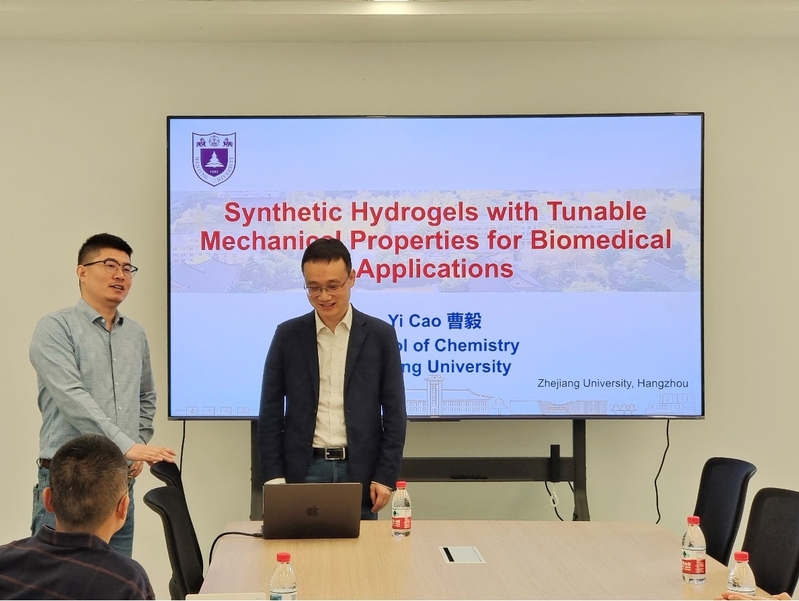
On May 8, 2026, the 40th Lv Weixue Academic Forum, hosted by the College of Biomedical Engineering & Instrument Science (CBEIS), was successfully held at Teaching Building 6 on the Yuquan Campus, featuring a talk on the theme Synthetic Hydrogels with Tunable Mechanical Properties for Biomedical Applications. CBEIS was honored to invite Professor Cao Yi of Nanjing University— a Jiangsu Distinguished Professor, and Editor-in-Chief of Biophysics Reviews—who delivered a talk to faculty and students on Rational Design of Mechanically Tunable Hydrogels and Their Biological Applications. The forum was hosted by Tian Liangfei, a Researcher under Zhejiang University's Hundred Talents Program.
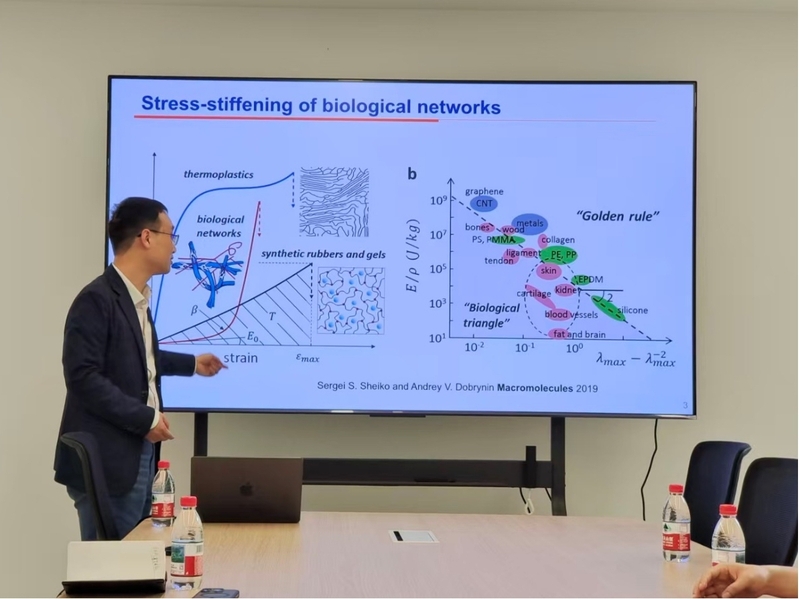
Professor Cao Yi gave a systematic overview of his team's latest research on the mechanical regulation of hydrogel materials, optimization of interfacial adhesion, and elucidation of cell biophysical mechanisms, offering innovative solutions for applying biomaterials in tissue repair and regenerative medicine. As core carriers for tissue engineering and implantable devices, biological soft-matter materials have mechanical properties that directly determine their functional performance. The talk emphasized that such materials must not only provide mechanical support for cell growth and tissue regeneration, but also regulate, through mechanical signaling, key biological processes such as stem cell differentiation, extracellular matrix component synthesis, and self-assembly. However, achieving precise matching between a material's mechanical properties and those of native tissue remains a major challenge in the field.
To address this challenge, Professor Cao Yi's team used hydrogels—a representative class of biomaterials—as their research subject and pioneered a bottom-up research strategy. Starting from an analysis of materials' microscopic structures, the team investigated in depth the mechanical response mechanisms of load-bearing units, successfully constructing rational design models for macroscopic mechanical properties and developing novel hydrogel materials capable of spatiotemporal, dynamic tuning of mechanical characteristics. This breakthrough overcomes the limitations of trial-and-error approaches in traditional materials design, providing both theoretical grounding and a technical pathway for developing customized biomaterials. In terms of interfacial design, the team focused on optimizing adhesion between biomaterials and native tissue; through molecular-level interfacial modification and structural design, they significantly improved the efficiency of material–tissue integration, opening new directions for interfacial design in tissue-inductive materials and engineered scaffolds. In addition, the research revealed in depth how materials' macroscopic and microscopic mechanical properties regulate cell growth, migration, and stem cell differentiation, clarifying key cell biophysical mechanisms involved in tissue regeneration. Professor Cao Yi noted that these findings not only deepen the scientific understanding of the mechanical properties of biomaterials, but also provide important technical support for optimizing cell culture systems, developing tissue engineering scaffolds, and improving the performance of implantable devices. Looking ahead, the team will further advance the integration of basic research with clinical applications, accelerating the translation of biomaterials into regenerative medicine.