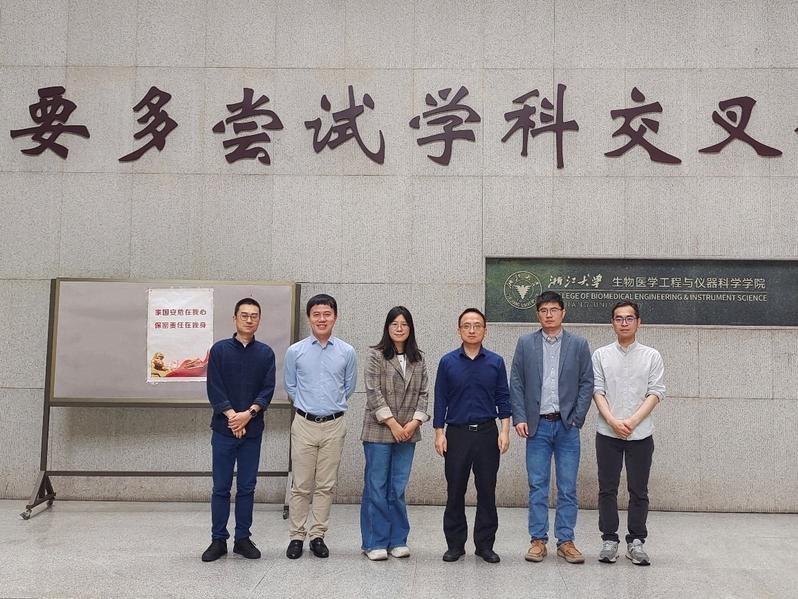
On April 27, 2026, the 37th Lv Weixue Academic Forum, hosted by the College of Biomedical Engineering & Instrument Science (CBEIS), was successfully held at the Zhou Yiqing Building on the Yuquan Campus, featuring a talk on the theme Super-Dynamic Hydrogels and Their Biomedical Applications. CBEIS was honored to invite Professor Bian Liming, Vice Dean of the School of Biomedical Sciences and Engineering at South China University of Technology, a Changjiang Scholar Distinguished Professor of the Ministry of Education, a council member of the Chinese Society for Biomaterials and a Standing Committee member of its Regenerative Medicine Materials Branch, and Associate Editor of APL Bioengineering, who delivered a talk to faculty and students on Super-Dynamic Hydrogels and Their Biomedical Applications. The forum was hosted by Tian Liangfei, a Researcher under Zhejiang University's Hundred Talents Program.
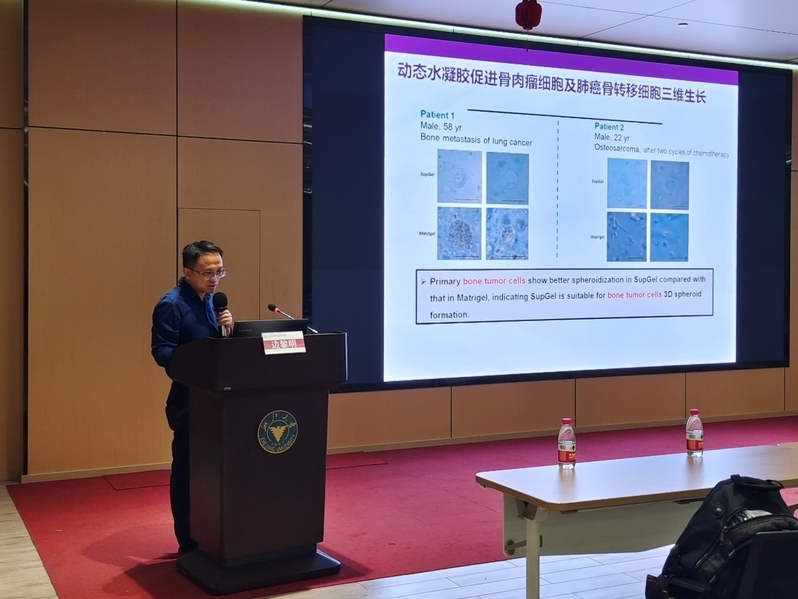
Professor Bian Liming gave a systematic overview of how the dynamic properties of polymeric biomaterials influence cell behavior. His research team has successfully developed a series of novel dynamic hydrogels based on reversible cross-linking mechanisms. These hydrogels feature tunable elasticity, rapid stress relaxation, self-healing capability, bioadhesiveness, and injectability, providing powerful tools for uncovering how three-dimensional microenvironments regulate cell behavior. The research found that, when cross-link binding strengths are similar, dynamic hydrogels with higher dissociation rates enable faster cell-force-induced network reorganization, thereby promoting rapid spreading of encapsulated stem cells into a star-like morphology and triggering corresponding mechanosensing and differentiation processes. In addition, rapid three-dimensional spreading and mechanosensing by stem cells also depend on stable and precise chemical coupling between cell-adhesion ligands and the hydrogel network. This work proposes that the kinetic parameters of physical cross-linking in supramolecular hydrogels are a key factor governing cell–hydrogel interactions and three-dimensional cell behavior. Experiments showed that host–guest cross-linked hydrogels with higher dissociation constants can effectively promote cell spreading and mechanotransduction through cell-force-mediated network reorganization. At the same time, stable binding between cell-adhesion peptides and highly dynamic hydrogel networks plays an important role in enabling mechanosensing-dependent differentiation of stem cells in three-dimensional environments. Overall, this new class of super-dynamic hydrogels shows significant potential in regenerative medicine—not only as high-performance scaffold materials, but also as a highly tunable research platform for studying how cells respond to dynamic biophysical cues within three-dimensional microenvironments.