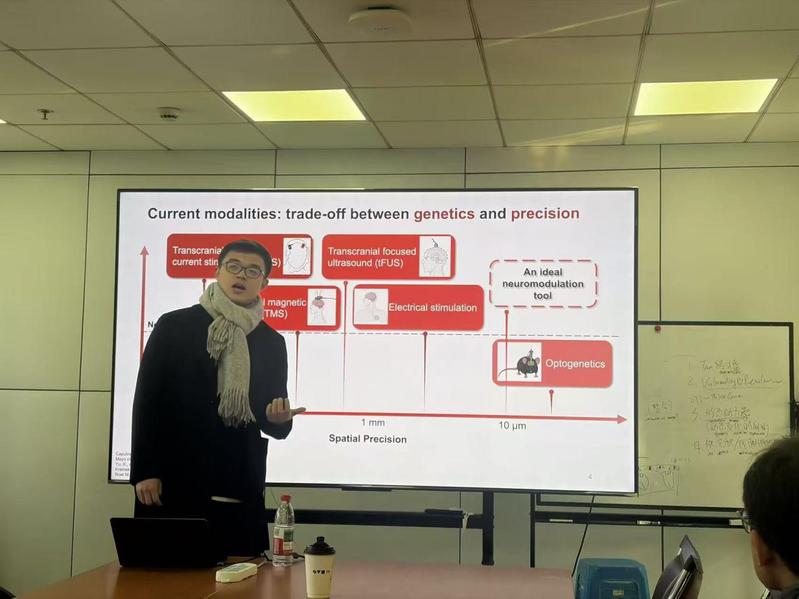
On the morning of January 22, 2026, the 224th Youth Academic Salon of the College of Biomedical Engineering & Instrument Science (CBEIS), held as part of the series of activities to enhance graduate students' research capabilities, took place in the fifth-floor conference room of the Zhou Yiqing Science and Technology Building. The salon featured a special invited talk by Dr. Guo Chen, titled Photoacoustic Neuromodulation: From Technology Development to Mechanism Understanding, with Researcher Hyeon Jeong Lee serving as the host. Faculty and students from the college actively attended, and the on-site discussion was lively.
Dr. Guo Chen will join the Janelia Research Campus of the Howard Hughes Medical Institute (HHMI) as a postdoctoral researcher in 2026. He previously earned his bachelor's degree in Optical Science and Engineering from Zhejiang University in 2020 and his Ph.D. in Electrical and Computer Engineering from Boston University in 2025. His research focuses on developing novel optical tools for neuromodulation and advanced imaging technologies.
In recent years, photoacoustic (PA) stimulation has become a popular technique for neuromodulation due to its advantages of high precision, programmability, and non-invasiveness. Starting from this technology, Dr. Guo Chen discussed several pressing challenges facing PA stimulation: thermal toxicity limits its in vivo applications, and its underlying biological mechanisms remain unclear. To address these limitations, he presented in this talk a next-generation photoacoustic transmitter architecture capable of improving conversion efficiency by tenfold—a performance breakthrough that lays the groundwork for mechanistic studies at the cellular scale. In addition, Dr. Guo Chen described an optical imaging system he designed to obtain direct optical evidence for understanding the mechanisms underlying photoacoustic modulation. Together, these advances form a robust framework that will help deepen understanding of, and enable the development of, better tools for photoacoustic neuromodulation.