On December 24, 2025, the 223rd Youth Academic Salon of the College of Biomedical Engineering & Instrument Science (CBEIS) at Zhejiang University, held as part of the series of activities to enhance graduate students' research capabilities, took place successfully in Room 326, Teaching Building 6, at the Yuquan Campus. This salon featured a special invited talk by Dr. Cao Xiaozhi, Research Scientist in the Department of Radiology at Stanford University, titled Rapid Quantitative Imaging Based on Magnetic Resonance Fingerprinting Technology. The event was jointly organized and hosted by Researcher Zhang Yi and Professor He Hongjian.
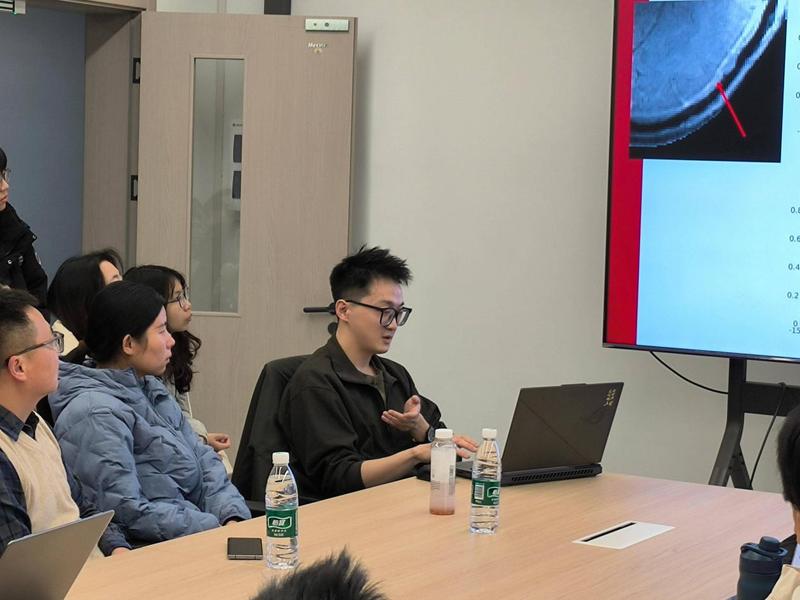
Dr. Cao Xiaozhi gave a systematic overview of Magnetic Resonance Fingerprinting (MRF) as a revolutionary MRI method that enables rapid, comprehensive acquisition of multi-parametric quantitative data. He noted that conventional quantitative MRI techniques require multiple separate scans to obtain different parameters—a process that is time-consuming and complex. MRF, by contrast, uses a series of rapidly varying pulse sequences to simultaneously acquire, within a single scan, signal fingerprints that encode multiple tissue properties; an efficient reconstruction algorithm is then used to generate accurate quantitative maps, fundamentally improving imaging efficiency.
In his talk, Dr. Cao elaborated in depth on the latest research framework and progress in this field. In terms of acquisition and reconstruction, his team has developed key technologies such as sliding-window methods, three-dimensional multi-axis spiral encoding, and subspace reconstruction, achieving a breakthrough from minute-scale to second-scale single-slice scanning, and enabling sub-millimeter-resolution three-dimensional whole-brain quantitative imaging to be completed within a few minutes. In terms of robustness and clinical practicality, by innovatively integrating motion estimation, B₁ transmit-field correction, and B₀ main-field correction modules into a unified imaging framework, the team has significantly improved the technology's stability and usability in real scanning scenarios. In terms of expanding the technology's boundaries, the team has successfully extended MRF from the conventional 3T field strength to both ultra-high-field 7T and low-field 0.55T systems, overcoming the specific physical and engineering challenges associated with different field strengths, and has further achieved simultaneous quantification of additional important physiological parameters such as diffusion coefficients, myelin water fraction, and blood flow velocity—greatly broadening its potential applications in neuroscience, oncology, and cardiovascular disease.